OnlyFans paid out about $5.7 billion to creators in 2024. The platform itself pocketed roughly $1.4 billion as the 20% commission. That $1.4 billion isn't a technology moat. The software underneath it — subscription billing, paywalled posts, creator messaging, content delivery — can be licensed today for less than what OnlyFans's London office spends on espresso. The moat is distribution, payment relationships, and trust. The code is a commodity.
This article is for the founders, agencies, and platform operators who have already done that math and don't need to be sold on the opportunity. You want to know how to actually ship — what to build, what to buy, what to outsource, and which decisions will burn you in month two if you get them wrong. We've shipped this category for clients out of London since 2014, we ship our own platform (OfEngine) on the same stack, and we've watched smart operators set $80,000 on fire making the same three avoidable mistakes. This is the playbook we wish they'd read first.
Skip ahead with the table above, or read straight through. We'll cover the real cost of building from scratch versus buying a clone script, the tech-stack decision nobody explains honestly, the payment-processing reality (Stripe will not work for you, and that's not a footnote), the compliance map across the UK, EU, and US, an unsentimental comparison of the four main OnlyFans clone scripts on the market in 2026, and a 60-day roadmap from license purchase to first paying subscriber.
1. Why founders are racing to launch the next OnlyFans
The creator economy crossed $250 billion in 2024 and is on track to break $500 billion before 2028. OnlyFans alone reported $7.21 billion in transaction volume for fiscal 2024, up roughly 19% year-over-year, with the parent company posting over $700 million in pre-tax profit on that revenue. Fansly, Fanvue, LoyalFans, JustForFans, and a dozen vertical-specific platforms are all growing double-digits behind it. The question stopped being is there a market sometime in 2022.
The interesting question now is structural. OnlyFans takes 20% of every transaction. Patreon takes 5–12%. Fansly takes 20%. Fanvue takes 15%. The creators on those platforms have collectively realised that the 20% they're paying isn't buying them technology — it's buying them payment processing, a small amount of fraud protection, and brand-name discoverability they no longer need once they're established. That's why the migration off OnlyFans into self-built or white-label platforms accelerated in 2023 and hasn't slowed since.
For an operator, the wedge is obvious. You build (or buy) the rails, you onboard the creators you can reach, and you keep the cut OnlyFans was taking. The 20% number is a feature, not a bug, of a market that is structurally inviting competition.
2. What an OnlyFans clone actually is — and three things it isn't
An OnlyFans clone is a creator-to-fan subscription platform that combines content monetization, direct messaging, paywalled posts, live streaming, and payment infrastructure in a single self-hosted or licensed stack. The phrase itself is sloppy shorthand for a specific category of software. Stripped of euphemism, the non-negotiable feature set is paywalled subscriptions with monthly and discounted multi-month tiers, pay-per-view (PPV) messages and posts, direct creator-to-fan messaging with media attachments, live streaming with tips and virtual gifts, a media vault for content storage and reuse, and an admin layer that handles creator approval, content moderation, and payouts.
Three things it is not, despite what the no-code crowd will tell you. First, an OnlyFans clone is not a Patreon clone — Patreon explicitly bans adult content and uses Stripe; the entire risk and compliance posture of that stack is different. Second, it is not a Memberpress theme on top of WordPress. WordPress was not built for the chat, streaming, real-time payment, or moderation volume this category demands; we have watched at least four founders try and abandon this path in their first 90 days. Third, it is not a Mighty Networks or Circle community with a paywall bolted on — those products are built for cohort-based knowledge communities and break the moment your unit economics require 1-to-1 paid messaging.
If your spec doesn't include all six of the items in the first paragraph above, you are not building an OnlyFans clone. You are building something else, and that's a different article.
3. Build from scratch vs. buy a clone script: the real cost and timeline
Founders ask us this question in the first call almost every time. Here are the honest numbers, drawn from projects we've quoted, shipped, or rescued since 2018.
Custom build from scratch — figure on £50,000 to £120,000 for a production-grade MVP delivered in six to nine months with a senior engineering team of three to four people. That estimate assumes you skip a native mobile app at launch (web-mobile only), use a managed payment processor rather than building your own ledger, and outsource moderation. Add a native iOS app and you're looking at another £30,000–£60,000. Add a web3 / crypto rail and add another £20,000. The cost ceiling is genuinely unbounded; we've seen well-funded competitors spend $1.5M on platform v1 and ship a worse product than a $2,500 licensed script.
Buy a clone script — the going rate for a serious self-hosted creator-economy platform in 2026 is between $700 and $3,000 for a lifetime license with source-code access. Add hosting (under $500/month for the first 10,000 users), branding customization ($2,000–$8,000 if you outsource it), and a high-risk merchant account setup ($500–$1,500 in onboarding fees). Total spend to first paying subscriber: roughly $5,000–$15,000 in cash and 6–10 weeks in calendar time. That's an order of magnitude less than custom and ships in a tenth of the time.
The bridge option — buy a clone script with full source-code access and pay an agency $10,000–$30,000 to customize it heavily into your differentiated product. This is what we recommend to roughly 70% of the founders who come to us. It compresses the custom-build timeline by six months while still giving you a defensibly differentiated product.
If your total platform budget is under $50,000 or you need to ship in under 90 days, buy a clone script. If you have a genuinely novel feature set and $200,000+ to burn before revenue, build custom. Everyone else lives in the bridge option.
4. The non-negotiable feature list for a production platform
A production-grade OnlyFans clone requires nine non-negotiable features at launch: subscription tiers, pay-per-view content, direct creator-to-fan messaging, live streaming with virtual gifts, a reusable media vault, a creator analytics dashboard, a platform admin layer, mobile-responsive design, and a DMCA takedown workflow. Whether you build, buy, or bridge, this list is broadly the same. We've audited a dozen platforms in this category over the last three years. The features below are the ones whose absence has cost real money in real launches.
- Subscription tiers with monthly recurring, discounted 3/6/12-month plans, and a free trial mechanic that doesn't bleed your processor fees.
- Pay-per-view (PPV) messages and posts with one-tap unlock, locked previews, and bundle pricing.
- Creator-to-fan direct messaging with paid attachments, tipping inside the thread, and an AI auto-reply layer (this stopped being optional in 2024).
- Live streaming with virtual gifts, tip overlays, and webcam support — RTMP ingress, HLS playback, low-latency CDN out.
- Media vault with reusable content, watermarking, and ideally multi-cloud storage so you can move providers if a host has second thoughts about your business.
- Creator dashboard with revenue analytics, fan lifetime-value tracking, and a built-in CRM with tags and segments.
- Platform admin with creator approval flow, KYC/ID verification, moderation queue, payout management, and dispute handling.
- Mobile-responsive web at absolute minimum. 80%+ of traffic in this category is mobile; a desktop-first build is a non-starter.
- DMCA takedown workflow and content fingerprinting. If you don't have this on day one you will have a worse version of it after your first leak — at 2 a.m., during a billing cycle.
5. The tech-stack decision: Laravel + React vs. MERN vs. no-code
This is the decision every founder pretends is technical and that's actually a hiring and TCO decision. Three real choices in 2026.
No-code (Bubble, Adalo, FlutterFlow) — the ceiling is roughly 10,000 active users before performance, payment-edge-cases, and rate-limited integrations start breaking the experience. Below that ceiling, no-code is genuinely a faster path to a working MVP. Above it, the migration to a real stack costs you everything you saved, plus six months. We do not recommend no-code for any operator who expects to scale.
MERN (MongoDB + Express + React + Node) — the dominant stack of the previous generation of OnlyFans clones, including Fanso. JavaScript everywhere is a real productivity win for small teams. The downside, particularly at scale, is twofold. First, Mongo is genuinely awkward for the relational data this category has — subscriptions, billing cycles, hierarchical permissions. We've watched MERN platforms move portions of their data to Postgres at the 100,000-user mark. Second, the senior-Node hiring pool is smaller and more expensive than the senior-PHP pool, particularly offshore. Expect $90–$160 per hour for a senior Node engineer vs. $40–$80 for an equivalently senior Laravel engineer.
Laravel + React — the stack we ship on, the stack OfEngine uses, and the stack we recommend for any operator planning to scale past 50,000 users without burning capital on talent. Laravel's ecosystem is mature for the things this category needs in particular: queued jobs (for media processing), webhooks (for payment processors), encrypted storage, and a battle-tested Stripe and Cashier integration that has been hardened by the fintech industry for a decade. The hiring pool is enormous, the security patching cadence is institutional, and the offshore talent market is deep.
If you're starting from scratch in 2026 with a serious operator's posture, Laravel + React is the conservative, correct answer. MERN is defensible. No-code is a trap above 10,000 users.
6. Payment processing for adult content (the section nobody writes)
Stripe explicitly bans adult content — OnlyFans clones cannot use Stripe for fan billing. The 2026 payment stack for adult subscription platforms is CCBill, Segpay, Epoch, or Paxum, with blended fees of 14–18% rather than Stripe's 2.9%. This is the section that has cost founders we know the most money and the most calendar time. Every clone-script blog post says "integrate Stripe." So do PayPal, Square, and basically every "low-risk" processor a normal SaaS founder would reach for. If you launch an OnlyFans clone on Stripe, your account will be frozen within two to twelve weeks, your customer funds will be held for 90+ days, and your business will be effectively dead until you migrate.
The real payment stack for this category in 2026 looks like this:
- CCBill — the historical default for adult subscription. 14.5% blended fees including chargeback handling, deep recurring-billing tooling, established underwriting team. Slow to onboard (4–8 weeks).
- Segpay — similar profile to CCBill, slightly more modern API, comparable fees. Often the better choice for newer platforms.
- Epoch — global coverage, strong on cross-border, slightly higher fees but better fraud rejection.
- Paxum — used primarily for creator payouts rather than fan billing. Most platforms run CCBill or Segpay for collection and Paxum for disbursement.
- Crypto rails (NowPayments, Coinbase Commerce) — viable as a complement, not a primary. The challenge is no longer accepting crypto; it's converting back to fiat through a banking partner that won't close your account.
Two more numbers to plan around. Chargeback rates in adult content run between 0.8% and 3.5%, versus 0.2–0.6% in mainstream e-commerce. Anything over 1.0% sustained will get you placed in chargeback monitoring programs (VISA's VDMP or Mastercard's ECP) with additional per-transaction surcharges. Build chargeback prevention — 3D Secure 2 (SCA) enforcement, address verification, velocity checks — into your launch spec, not your roadmap. And start your high-risk merchant account application on day one of your build, not day 30. Underwriting takes eight to twelve weeks. Plenty of founders have shipped finished platforms with no way to take money.
7. Hosting, scaling, and the true monthly run-rate
The marketing pages of every clone-script vendor promise "scales to millions of users." The honest infrastructure cost curve looks like this.
Year 1 (0–10,000 paying users): $80–$300/month is realistic for a well-architected Laravel + React platform. A $20–$50 VPS for the application server (DigitalOcean or Hetzner), a $20–$60 managed Postgres or MySQL cluster, object storage on Backblaze B2 or Cloudflare R2 for media (B2 and R2 are dramatically cheaper than S3 for this category), and Cloudflare's free tier or Bunny.net at $10/month for CDN. You can run a profitable platform in this band for a long time.
Year 2 (10,000–100,000 paying users): $400–$1,500/month. Bigger application servers (or a small fleet behind a load balancer), a dedicated database, Redis for sessions and chat, a media-transcoding pipeline, and a CDN budget that starts to matter — adult content gets aggressive scraping and high egress. Plan for an on-call DevOps contractor by the upper end of this band.
Year 3 (100,000+ paying users): $2,000–$6,000/month, depending heavily on how much live streaming and how much video content your creators push. At this scale you need multi-region failover, dedicated transcoding workers, and a serious storage strategy — most platforms at this size run hot storage on R2/B2 with cold archive on the same providers' archival tiers.
Two scaling traps. First, live streaming bandwidth and storage will outpace your fan growth — budget for it independently. Second, AWS will eventually figure out what you are doing and politely ask you to leave; adult-friendly hosting includes M247, OVH (case-by-case), Hostwinds, and a handful of European specialists. Build your platform so you can migrate hosts in 48 hours, because one day you will.
8. Legal, KYC, and age-verification — the 2026 compliance map
OnlyFans clone operators must comply with three jurisdictional regimes in 2026: the UK Online Safety Act (effective July 2025), the EU Digital Services Act, and US 18 U.S.C. §2257 record-keeping requirements. All three require highly-effective age verification for users and KYC for content creators. The compliance picture shifted hard in 2024–2025; if you read an article on this topic from 2022, the rules it cites are now wrong.
United Kingdom — the Online Safety Act came into full effect for adult content in July 2025. Any platform accessible to UK users that hosts adult content must implement highly effective age assurance for users, not just a checkbox. Acceptable methods include credit-card verification, government ID via a regulated provider (Yoti, Persona, Veriff, AgeCheck), or facial age estimation. The fines for non-compliance run to 10% of global revenue.
European Union — the Digital Services Act applies in full to any platform with EU users. Notice-and-action systems for illegal content, transparency reporting if you cross 45M monthly active users, and a designated EU legal representative if you're based outside the EU. For platforms specifically hosting adult content, several member states (France in particular) have layered on age-verification requirements that broadly mirror the UK's.
United States — 18 U.S.C. §2257 record-keeping requirements apply to any producer or secondary producer of adult content. You must maintain age-verification records for every performer, with redundant ID copies, indexed and searchable, available for inspection. Several states (Texas, Louisiana, Virginia, Utah, and roughly fifteen others as of 2026) have additional age-verification requirements for end users.
The practical KYC stack for creators looks like Persona, Veriff, or Onfido (price: roughly $1–$3 per successful verification). The end-user age-verification stack looks like AgeCheck or Yoti at $0.10–$0.30 per check. Register a DMCA agent with the US Copyright Office ($6 — yes, six dollars — and absolutely do this). Form an LLC in Delaware or a UK limited company; do not run this as a sole trader, regardless of how small you start.
9. Comparing the top OnlyFans clone scripts on the market in 2026
There are roughly forty products in this category if you count abandoned CodeCanyon listings and white-label resellers. Four matter for serious operators. We've installed, audited, or reverse-engineered all four. Here's the honest comparison.
| Feature | Scrile Connect | Fanso | xFans | OfEngine |
|---|---|---|---|---|
| Hosting model | SaaS (vendor-hosted) | Self-hosted | Self-hosted | Self-hosted |
| License | Monthly + revenue share | Lifetime | Lifetime | Lifetime |
| Source code access | No | Yes | Yes | Yes |
| Stack | Proprietary | MERN | PHP (legacy) | Laravel + React |
| AI auto-reply | Add-on | No | No | Built-in |
| Multi-cloud storage | No | Single (S3) | Single | Six providers |
| Best for | Non-technical operators | JS-native teams | Tight-budget MVPs | Operators scaling past 50k users |
Scrile Connect is the most polished sales experience and the worst long-term economics. It is SaaS, not self-hosted; you do not own the code, you cannot move providers, and you pay both a monthly subscription and a percentage of revenue indefinitely. For a non-technical operator who wants the fastest possible launch and has no intention of scaling past a small creator roster, Scrile is defensible. For anyone with growth ambitions, it inverts the entire economic argument we made in section one.
Fanso is the popular MERN-stack incumbent. The codebase is mature, the documentation is fine, and the price point is competitive. The drawbacks are stack-related (see section five) and the AI feature set has lagged the market since 2023. If you have a Node-native team and don't care about AI messaging, Fanso is a credible choice.
xFans is the budget option. A PHP codebase with mixed reviews on code quality and a smaller development community. We've installed it twice and recommended it once — to a founder explicitly building a 3-month MVP to test market fit before reinvesting.
OfEngine is the platform we ship and the one we recommend to operators planning to actually scale. Laravel + React, lifetime license with full source code, built-in AI auto-reply trained on creator tone, a multi-cloud media vault that lets you migrate hosts in hours, Stripe integration for the (small) portion of platforms doing non-adult subscriptions, and direct support pathways for high-risk payment processor configuration. It is the product we would buy if we weren't already shipping it.
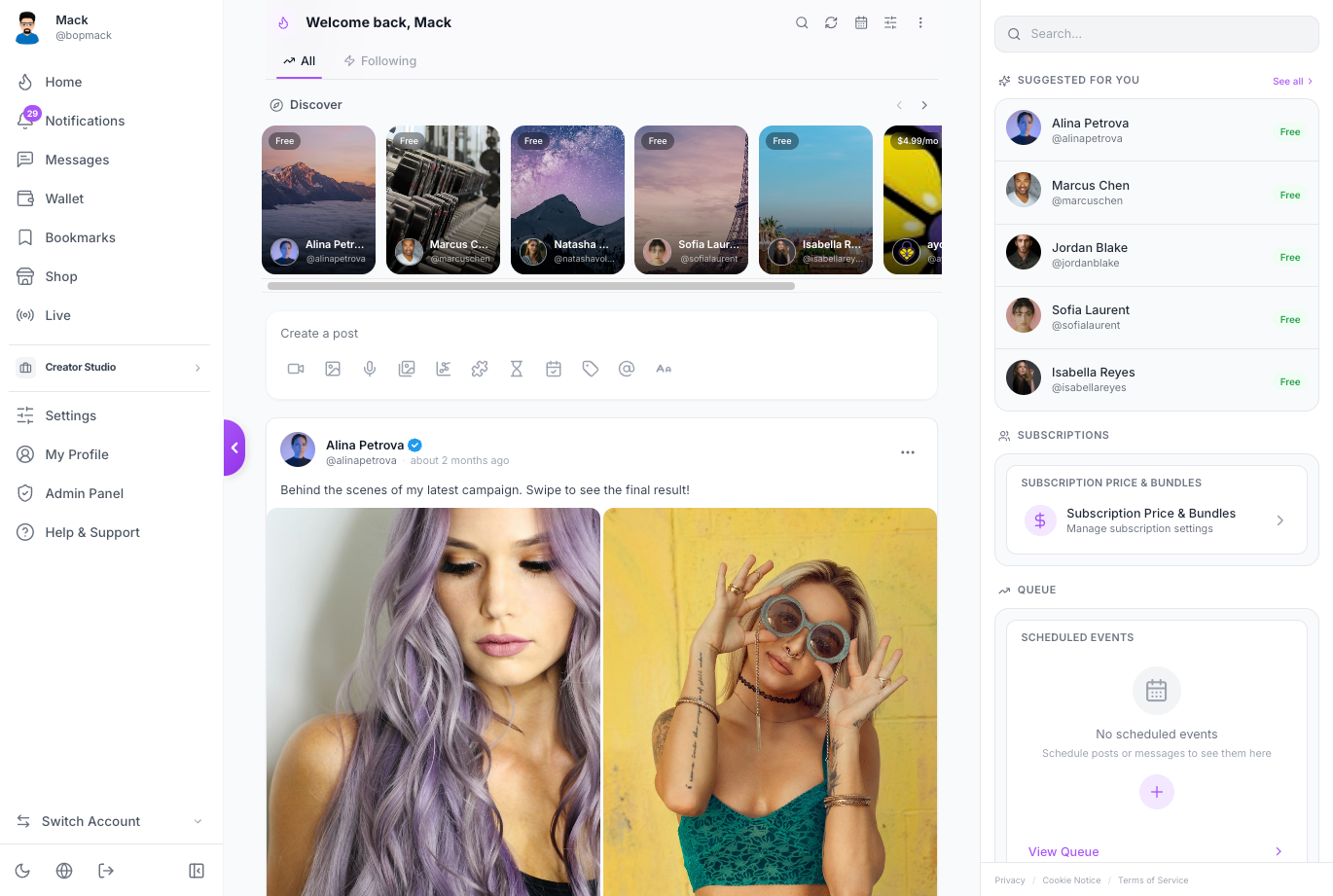
OfEngine — the operator-grade OnlyFans clone
Laravel + React, lifetime license, full source code, multi-cloud media vault, built-in AI auto-reply, and tested integrations for CCBill, Segpay, and Stripe. Ship to first paying subscriber in 60 days.
See OfEngine10. The five objections every founder raises (and the honest answers)
"What about support and bug fixes?" A self-hosted platform means you own operations. The best clone scripts ship with active dev communities, documented APIs, and (in OfEngine's case) optional support contracts from the engineering team that built the product. We sell ongoing support to OfEngine operators through NOW2CODE; pricing starts in the low four figures per month depending on traffic and SLA.
"Can I really keep 100% of revenue?" No, and any vendor who says otherwise is lying. Your effective platform cut, after payment processor fees (14–18% on adult content), hosting (~2–4% of revenue at scale), moderation ($0.50–$2 per active creator per month), and support, lands at about 75–80%. The relevant comparison is to OnlyFans's setup, where the creator gives up 20% to OnlyFans and then a further 3% to Stripe — about 23% gone before you net anything. Self-hosted nets roughly 18–22% to the platform operator and a much higher payout to the creator. Both sides win.
"What if my host kicks me off?" They will, eventually, if you scale on a non-adult-friendly provider. Build for portability. OfEngine's multi-cloud storage is specifically designed for this; the application code is hostable on any Laravel-friendly provider in under a day. Adult-friendly hosting providers in 2026 include M247, OVH (case-by-case underwriting), Hostwinds, KingHost (Brazil), and several European specialists. Maintain a warm secondary deployment from day one.
"What about content moderation?" Outsource. Hive AI and Modulate handle automated scanning for CSAM, violence, and policy violations; budget $200–$800/month at small scale, scaling with volume. Human moderation services like Webpurify or Cogito handle escalations at $1–$3 per reviewed item. Do not, under any circumstance, try to do this in-house manually. The legal liability if you get it wrong is unbounded, and the psychological toll on whoever you put on the queue is real.
"What about legal protection?" Form an LLC (Delaware) or limited company (UK) the same week you start the build. Cyber-liability insurance (~$2,000–$5,000/year), general liability (~$800–$1,500/year), and EPL coverage if you have employees. Total annual legal-and-insurance run-rate: roughly $4,000–$10,000. Cheap.
11. A 60-day launch roadmap from purchase to first paying subscriber
This is the schedule we put in front of every operator after the buy-decision. Aggressive but not unrealistic.
-
Days 1–7
Purchase clone-script license, form your business entity, file your DMCA agent registration, start the high-risk merchant-account application (this is the long-pole item — eight to twelve weeks of underwriting). Open the application now, not after the platform is built.
-
Days 8–21
Deploy on a staging environment. Customize branding (logo, colours, copy). Integrate test payment processor. Wire up KYC for creators. Internal QA — load test, edge-case test, payment-flow test. This is where 60% of the engineering time goes.
-
Days 22–35
Soft launch with five to ten invited creators. No public marketing yet. Fix every bug that surfaces. Validate the moderation pipeline with real content. Validate the payout flow with real money. This phase always exposes things that internal QA missed.
-
Days 36–49
Public soft launch. Switch merchant account from test to live. Open creator signups. Monitor your core funnel — signup rate, KYC pass rate, payment success rate, support ticket volume. Iterate on whichever number is the weakest.
-
Days 50–60
Run your first paid acquisition campaign — small spend, tight cohort, measure CPA against creator LTV. By the end of day 60 you should have first paying subscribers and a measurable cost-per-acquired-creator number to plan from.
12. Final verdict: who should build custom, who should buy, and how to choose
Three honest paths, depending on your situation.
If you have $1M+ in capital, a genuinely novel feature set, and 12 months before you need revenue — build custom. You will spend more than you think and ship later than you want, but you'll have exactly the platform you imagined. This applies to maybe 5% of the operators who read this article. (You probably stopped reading at section three.)
If you have $50,000–$150,000 and want to differentiate hard in a specific vertical or geography — buy a clone script, then pay an agency to heavily customize it. This is the bridge option. The end product is functionally a custom build at 30% of the cost and 25% of the timeline. This is roughly 70% of the operators we work with.
If you have under $50,000 and want to ship in 60 days to validate the market — buy OfEngine, customize what matters (your brand, your two or three differentiator features), and put the saved capital into creator acquisition. You can always rebuild later from a position of revenue. The best operators we know got rich by shipping fast and iterating, not by holding out for the perfect launch.
Whatever you choose, choose this week. The market opened in 2020 and the window for new entrants is wide but not infinite. The operators who closed $5M+ ARR in this category in 2024 and 2025 were not the ones with the best technology. They were the ones who launched first, fixed fast, and reinvested early.
If you want to talk through your specific situation, we do free 30-minute strategy calls with operators who are seriously planning to ship in 2026 — book one here. If you'd rather just see the product we'd recommend, OfEngine is here.
You're one good decision from owning the rails instead of renting them.
OfEngine is the production-grade, Laravel + React, self-hosted OnlyFans clone we ship and stand behind. Lifetime license, full source code, real engineering support.